
This guide builds order confirmation from collaborating objects. By the end, you will be able to locate a business rule, an application intention, a persistence boundary, and a transport boundary without reading the entire framework.
Read Your first application first. The complete domain example lives in examples/orders/domain.rb and runs without requiring the framework.
Begin with a business decision
An order starts pending, has a nonnegative total, and can be confirmed once if its total is positive. The object that owns that state also owns the decision:
class Order
  attr_reader :state, :total_cents

  def confirm
    raise OrderNotConfirmable unless state == "pending" && total_cents.positive?
    @state = "confirmed"
  end
end
The complete class checks constructor invariants too. A negative total or an unknown initial state is rejected during construction. confirm checks the invariant that depends on the order’s current state.
Keeping this decision on Order means an HTTP controller, an RPC controller, and a command-line caller all encounter the same rule. If a controller set state = "confirmed" itself, every transport would have to remember both the state transition and the conditions that make it legal.
Name the complete intention
ConfirmOrder coordinates the intention using an injected repository:
class ConfirmOrder
  def initialize(orders:)
    @orders = orders
  end

  def call(order_id:)
    order = @orders.fetch(order_id)
    order.confirm
    Confirmation.new(id: order.id, state: order.state,
                     total_cents: order.total_cents)
  end
end
The use case chooses the collaboration: retrieve this order, ask it to confirm, and describe the resulting public state. It does not decide whether a cancelled order can be confirmed. It does not choose a database connection or a response status. Those decisions belong to collaborators with different reasons to change.
The result is a Data value named Confirmation. Its fields are copied by the invocation before the session closes. A future endpoint can add presentation fields without giving the caller the managed Order itself.
Exercise the collaboration directly
The following program supplies a tiny repository collaborator and confirms the order twice:
require_relative "../orders/domain"

order = OrdersExample::Order.new(id: "ready", total_cents: 1500)
repository = Object.new
repository.define_singleton_method(:fetch) { |id| order }
confirm = OrdersExample::ConfirmOrder.new(orders: repository)
puts confirm.call(order_id: "ready").state
begin
  confirm.call(order_id: "ready")
rescue OrdersExample::OrderNotConfirmable
  puts "An order can only be confirmed once"
end
ruby examples/guides/03_order_domain.rb
Expected output:
confirmed
An order can only be confirmed once
The repository double answers exactly the message the use case needs: fetch. It does not imitate a database engine. This test asks whether the collaboration produces the intended behavior; storage isolation will have its own contract.
Notice that the second call raises an ordinary application exception. Domain exceptions retain meaning before a transport assigns them a public status. The HTTP application later registers OrderNotConfirmable as a conflict.
Assign the remaining responsibilities
The running application adds these collaborators:
| Collaborator | Decision it owns |
|---|---|
Order |
Whether its state transition is legal. |
ConfirmOrder |
Which objects collaborate to fulfill confirmation. |
Orders repository |
How application code asks for an order. |
| External mapping | How order attributes correspond to stored values. |
Session |
Which Ruby object represents an identity during this execution. |
Invocation |
Scope creation, materialization, transaction policy, cleanup. |
| HTTP or gRPC controller | How transport input becomes use-case arguments. |
| Presenter | How independent results or public failures become protocol output. |
These are boundaries between decisions, not a requirement to introduce a new class for every line of code. The greeting used a string as a collaborator. The repository wrapper is useful here because fetch(order_id) expresses an application need without exposing mapping classes to the use case.
Follow one execution
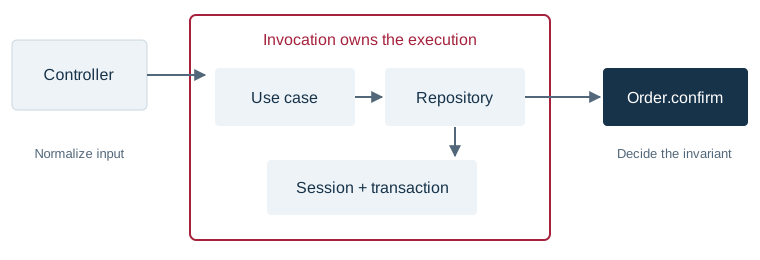
For POST /orders/ready/confirm, the controller extracts order_id. Invocation opens a write transaction and builds Orders with that execution’s session. The repository obtains one Order from the session. ConfirmOrder sends confirm, builds the confirmation value, and returns. Invocation materializes that value, flushes changes, commits, and closes resources. Only then does the presenter construct the response body.
This order has a consequence: failure to send the response can occur after a successful commit. The client may need to inspect the resource before deciding whether another command is appropriate. Automatically retrying the intention would hide that distinction and could repeat effects.
Compare the tradeoffs
A Data Mapper keeps persistence descriptions outside the domain class. This allows domain objects to have ordinary constructors and invariant-preserving methods. It requires explicit mappings, identity tracking, and care when hydrating an object whose stored state is invalid.
An Active Record design would put more storage behavior on the entity itself. That can reduce composition code for CRUD applications. This framework chooses external mapping because the domain object should be able to participate in a plain Ruby collaboration before storage is present.
Constructor injection makes required collaborators visible. It introduces factory declarations at the composition root. A hidden container lookup would save those declarations, but understanding a use case would then require finding the container’s runtime state as well as reading the class.
The same principle applies to transaction ownership. ConfirmOrder has one application intention; Invocation applies the declared storage policy around it. When a streaming controller invokes several intentions, each invocation can finish its own transaction rather than borrowing the lifetime of a network stream.
Inspect the executable evidence
Read the domain source, the composition root, and the order example scenarios. The scenarios demonstrate direct invocation, HTTP success, absence, business rejection, a real concurrent commit conflict, and an unexpected storage error.
Next step
In Composition and execution, give these collaborators a precise lifetime. As an exercise, add a shipping restriction to the order: decide whether it depends only on order state or needs another domain collaborator before choosing where to put the rule.